Showing posts with label running session. Show all posts

Saturday, June 24, 2023

Progress Report 97

This is an interesting time of year for Peckforton Light Railway. As the days grew longer, things started gearing up in preparation for the first full running session of the season. However, this was very much dependent on the weather. To set up the first full running session I really need to have a guarantee of three consecutive rain free days: half a day to clear the track and set up the buildings and other lineside accoutrements, half a day to deploy and check the rolling stock, half a day to prepare the running schedule and then a day and a half to run a full operating session. In actuality, I sometimes need four full days as a fair bit of time is taken up with caring for my 102 year old mother in the meantime, so I can't rely on having interrupted days for running trains.

However, running stock has been constructed, running sessions have been completed, visitors have been catered for, videos uploaded and some outdoor jobs completed.


Rolling stock

Hunslet - Hughie

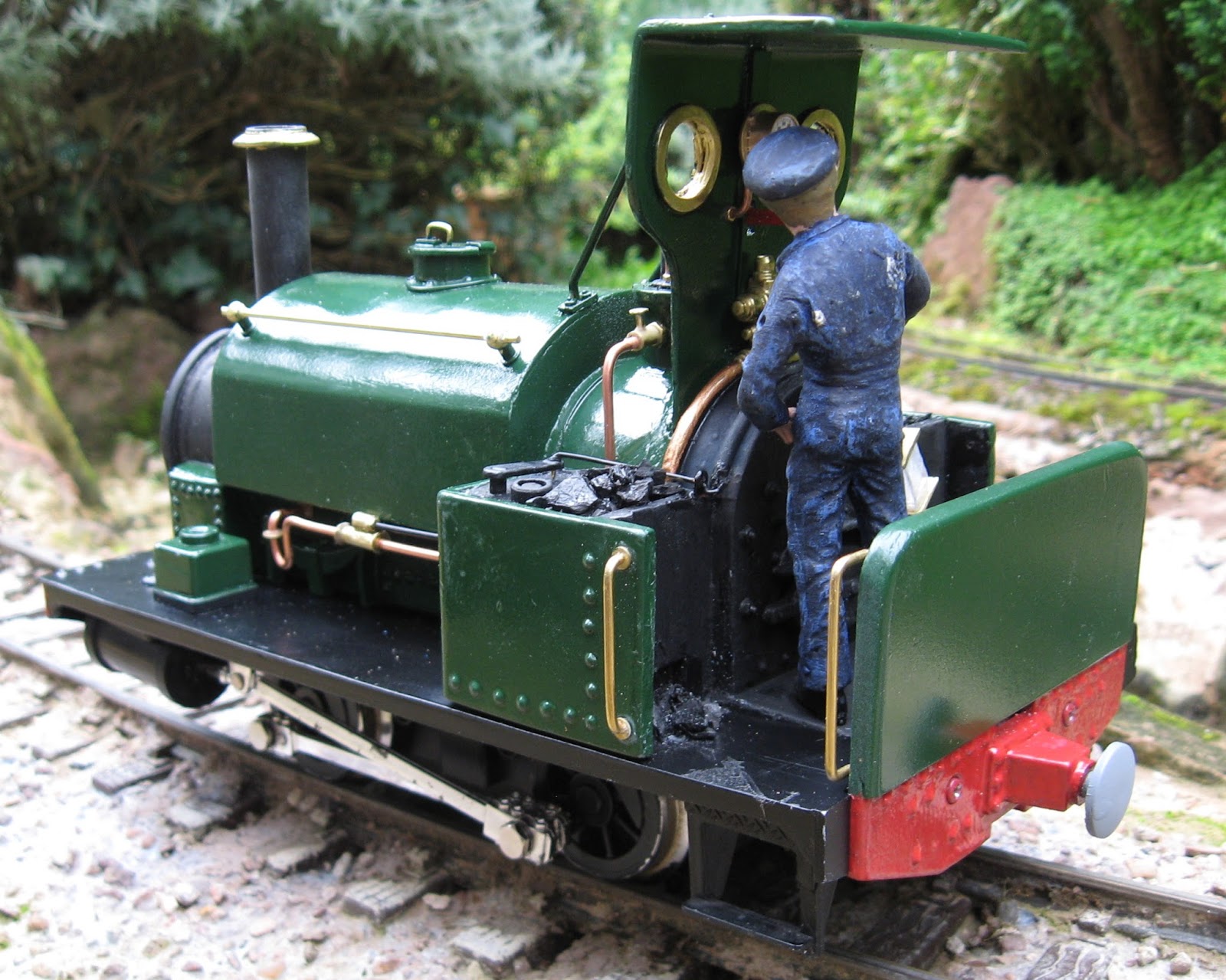
Ever since I started with my garden railway, I have been intrigued by the 16mm scale card models produced by LocoLines - now produced by Rail-Road. After seeing an article in Garden Rail detailing how a modeller makes all his 16mm stock from card, I decided to give one of the Rail-Road card kits a try. In my previous Progress Report, I outlined construction of the basic kit - but since then I have enhanced the kit with a decent motor block, a new chimney, backhead detail, new springs and sandboxes and handrails and pipework.

The additional 3D printed detailing parts are available as free downloads on the Thingiverse.com website (registration required) and the GardenRails.org forum (registration required)

For more information see How I assembled a Rail-Road card kit

I am now in the process of producing a 3D printed version of a similar loco and am trying to decide whether to replace the card version or complement it.


GVT Glyn motor block

In my previous progress report I described how I had constructed a 3D printed model of a Glyn Valley Tramway Beyer Peacock tram loco. I was disappointed with the performance of the Bachmann motor block I had used to power it .....

..... and so designed and 3D printed a replacement using an MFA Como gearbox motor.


However, I was also disappointed with this motor block's performance and so have now designed and 3D printed a second replacement using a larger and more powerful gearbox motor.
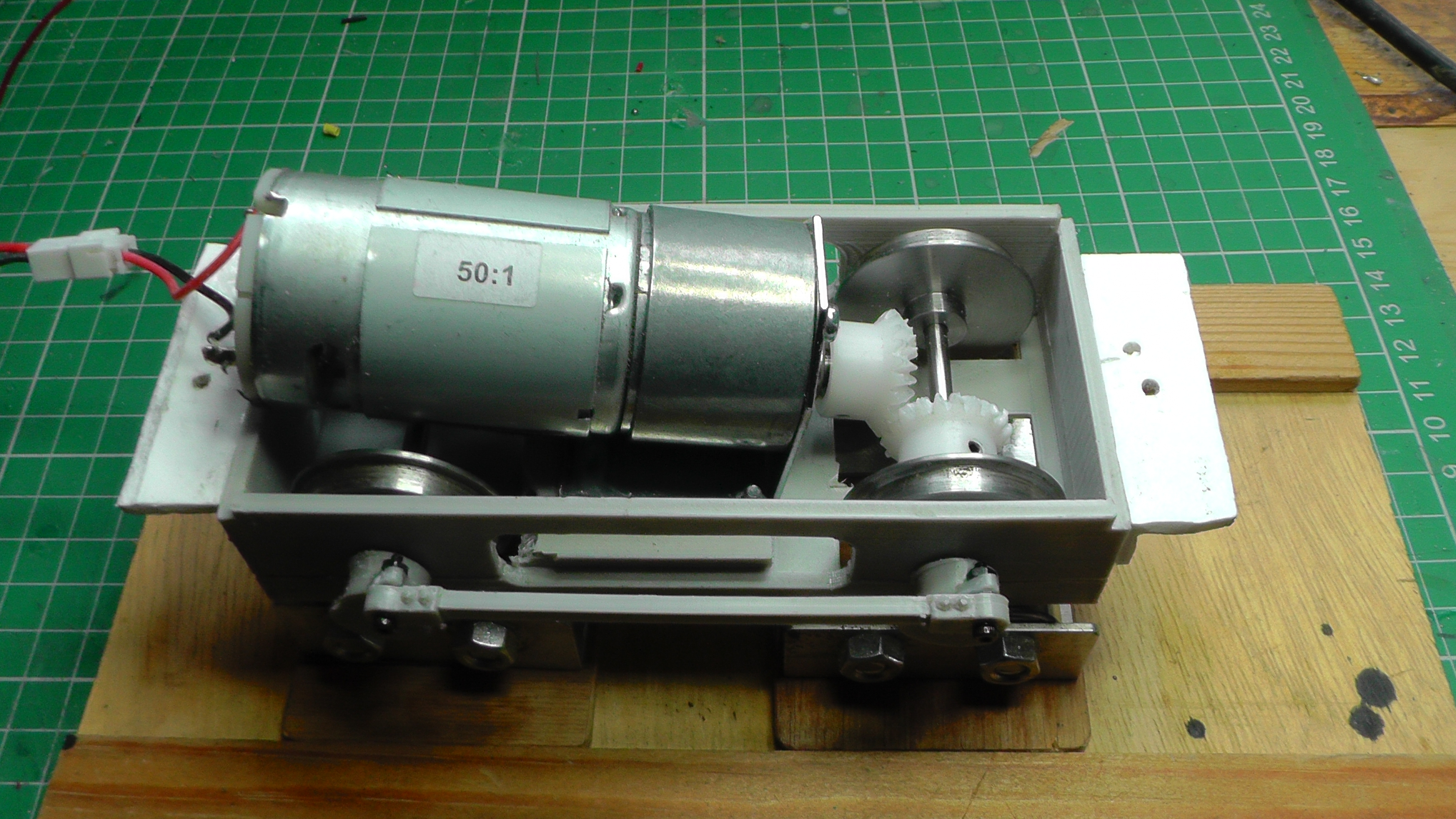

This has much better performance.


For more information, see How I created my own motor blocks (pending)


Directors' Saloon

This has been on my To-do list for many years but, having now completed the gatehouse for Peckforton Castle (see below), I felt it was time to make this plan a reality. The saloon is based on one of the various designs of Glyn Valley Tramway four-wheeled coaches (see How I constructed a GVT coach).


For more information see How I designed, printed and constructed a Directors' Saloon


Permanent Way and Infrastructure

Sand Quarry Extension

The siding for the sand quarry installed in 2018 (see Progress Report 75), was always slightly short - primarily because the space for it was quite tight.

I toyed with a few ideas for extending it, but eventually opted to turn the siding through 90 degrees and turn it into a link back to the mainline just outside Peckforton station. This provided an opportunity for me to designate this new junction as a siding to serve Peckforton Castle (bottom left on this plan).

The extension has now been constructed and its track tested and ballasted.


For more information see How I built the sand quarry extension


Lineside

Peckforton Castle Gatehouse

With the completion of the sand quarry extension and its incorporated junction for Peckforton Castle, I decided the entrance to this new siding needed to be recognised with a new structure. The resultant gatehouse was based on the gatehouse for real vehicular entrance to the castle.

My model was carved from four Thermalite blocks.


Operation

Operating sessions

As indicated above, my first operating session of the year has been delayed slightly by a range of conflicting factors. However, one full session has been run plus a couple of smaller scale partial operating sessions


Visitors

In addition, the railway has hosted a visitation by Zach Bond and his mate Theo who spent an afternoon (and evening) running live steam and a range of other scheduled and unscheduled train services.


Freight management Mk V

Over the years, I have produced four versions of my computerised freight management system:

They have each had their strengths and weaknesses. My favoured version (Mk III) was that which ran on my Psion 3a pocket computer but it's limitation was the 1Mb of RAM provided by the Psion - it would sometimes run out of memory half way through a running session.

So, I acquired a Psion Series 5 with a staggering (for 1997) 8Mb of RAM. However, because it's difficult to interlink Psions with modern computers, I had to hand type the code, copying it line by line from my old 3a to the Series 5. Some amendments needed to be made to the coding to take account of differences in the two machines' LCD displays and also some variations in the way the coding is handled but, after some cerebral effort and hard graft I now have a working version of the software on the Series 5


More figure scanning

Following Dean's (from DesignScanPrint3d) previous visit to 3D scan members of our local dramatic society in 1930s and 1940s costume - see Progress Report 95  


he paid us another visit to scan more figures, this time with more specific poses. I have now received the first batch of figures from him.


As you can see, these figures are more engaged in activities, rather than static poses. There will also be some seated figures to become passengers in my rake of recently finished GVT coaches (see Progress Report 95)


Other developments

Year long video

I am steadily working my way through my schedule to record the next monthly instalment of the Year Long Journey videos - depicting a mixed train travelling Down and back up the line in twelve monthly stages. 

June's Down sequence sees the train arriving at Peckforton and having some wagons shunted off and on by Doris, the timber yard's shunter.

While the Up shot is of the train passing the water mill on the approach to Peckforton.


By September the train will have completed its two journeys and I will be able to compile the two videos.


3D printer repairs

3D printers require a certain amount of nurturing to keep functioning successfully. My budget (£70) Anet A8 printer developed a fault which required the replacement of the heated bed.

Sometimes, it takes longer to track down the source of the fault than it does to repair it.

So, all in all, it has been quite a productive period since my last progress report. Despite not having had time to engage in more than one operating session, there have been plenty of other jobs to keep me actively involved. As the summer progresses, I aim to run quite a few more trains.


<< Previous Progress Report         -      Next Progress Report >>

Saturday, July 11, 2020

Progress Report 82

Introduction

For most of the time since my last progress report, the weather has been fairly bad - cold, wet and stormy. However, there were three days when it was warm and dry and so I managed to organise a good running session which I filmed, using Bulkeley Station as the focal point.

There have been a few other developments but, because of the weather, most of these have been inside the workshop.

Lineside and Permanent Way

On those few occasions when the weather improved, I have been able to finish off a few outside jobs.

Cable operated points at Beeston Market

The points on the far side of Beeston Market Station are just about in reach, if I stretch across the tracks. However, if the siding to the cattle dock is full and/or there are wagons or coaches on the main station loop, then it can be tricky to change the points. The pointwork leading to the 'exchange siding' is used frequently during an operating session and so improving access to the point lever became an increasing priority.


As the points were just over a metre from the edge of the baseboard, I decided to use bowden cable (ie bike brake cable) which I ran beneath the baseboard from each of the two points.

The points are now a lot easier to operate at a distance.


Sound modules

After shooting and editing a couple of videos recently where I added some ambient sounds - the sound of the sawmill in operation (see Lineside business on the PLR) and the sound of cattle in a cattle wagon (see Trainspotting at Bulkeley Station) - I felt it would be more interesting for visitors to the railway to have these sounds played live. So I invested in two small, self-contained MP3 cube players for the modest sum of slightly over £5 (GBP) each.

I downloaded the sounds of a sawmill and cattle lowing from various sources on the internet, edited them in Audacity to focus on the sounds I wanted to use and then saved them as WAV files on a couple of very cheap, low capacity micro SD cards. These were inserted into the MP3 players so the amplified sounds can be played as loops.

As the rechargeable batteries in the players last only a couple of hours, I am now investigating the use of Arduino circuitry to energise them either only when the wagon is in motion (for the cattle sounds) or only when a sensor detects the nearby presence of an observer (for the sawmill sounds).

Boneworks

Plans are now in hand to construct a building for the Boneworks siding at Bulkeley. This will be a half-relief model based on the old Bone and Flint Mill in Stoke on Trent which is now used as a museum.

Photograph taken 15 August 2000 © Mr Brian Peach LRPS. Source Historic England Archive ref: 384358

I am considering moulding the building in concrete so it can be left outside all year round and am currently experimenting with ways of representing the brickwork. Failing that, I'll revert to my now favoured method using PVC foamboard.

Workshop Test Track

A major development in terms of tracklaying has been the creating of a test track around the inside of the workshop. This was partly prompted by the wet weather and partly by the discovery of some Playmobil plastic track which has lain unused in the loft for the past ten years.

The test track is now available whenever I want to test-run a loco or some rolling stock - and also, I can run trains even when the weather outside is not conducive.


Rolling stock

There have been a few developments with rolling stock on the line - a new pair of locomotives have joined the roster, the new railcar has received a more appropriate soundcard, some of the stock has been weathered and I have replaced the last remaining plastic hook and loop couplings on my stock with my own version made from wire.

3D diesel(s)

Having recently bought a budget 3D printer ostensibly to create 14 identical seats for my County Donegal railcar (See How I constructed a railcar from an etched brass kit), I wondered whether it would be capable of printing out something more complicated and so downloaded a freebie kit for a narrow gauge diesel locomotive from the Thingiverse.com website. I also discovered that another modeller had added some enhancements to the basic kit and so I downloaded those as well. In the end, I decided to print out and construct two versions and then couple them together back-to-back in a similar manner to Australian sugar cane locomotives. For more information, see How I constructed a double diesel from 3D printed parts)

I was very pleased with how the larger pieces turned out, though I needed to make some adjustments to the printer to improve its consistency (see How I improved my budget Anet A8 3D printer - pending)

Railcar soundcard

After constructing a CDR Railcar from a John Campbell bare bones etched brass kit (see How I constructed a railcar from an etched brass kit), I installed a Dallee soundard designed for an American Galloping Goose railcar which I had bought secondhand on eBay. Although the sound quality was quite good, the sounds didn't seem quite right for a Perkins diesel powered former Irish railcar.

After watching the promo video of their latest diesel soundcard on the MyLocoSound website which indicated that one of the digitised sounds was of a Perkins diesel, which made it ideal.

I duly purchased one and installed it. The setup still needs to be tweaked a little but the sounds now seem far more appropriate.

Weathering

Weathering rolling stock is one of those jobs which I often put off. I can't think why as it's not difficult and quite an enjoyable task, but there always seem to be more important things to do! A couple of wagons which I constructed a few months ago were still in need of weathering and so, with the bad weather deterring me from running trains, they made their way into the workshop to be attacked.

One of the former Newqida van modifications (see How I bashed a Newqida closed van) was tackled first, following my usual approach (see How I weather my rolling stock)

This was followed by the open wagon which I had converted from a cheap Echo Toys gondola wagon (see How bashed a couple of cheap gondola wagons into opens)

Couplings

The final four items of stock have now been equipped with my versions of hook and loop couplings (see How I make my own LGB style hook and loop couplings)

I don't often run my Maddison coaches (see How I constructed coaches from Maddison kits) but they do occasionally appear on special trains. For this reason they have been languishing on a shelf in the workshop for far longer they they should. The couplings and buffers are attached to arms so they can swing round tight curves without compromising the couplings.

The R1 curves on the test track (see above) was therefore extremely useful in ensuring I had got the geometry right for the linkages and the coupling lengths - previously, the couplings were a bit too close to the coaches which meant the corners of the coaches touched when taking the curves.

The last loco to be converted to my own style of couplings was my HGLW diesel loco which potters about in the timber yard at Peckforton. I hope you will agree that its appearance has been enhanced by replacing the rather chunky LGB plastic hook and loop couplings .....

.... with my somewhat less obtrusive alternatives.

I appreciate that they are not prototypical but, because I need to do a lot of shunting on my railway, I wanted something which was reliable and also, as I have around 70 items of rolling stock, it needed to be cheap!

Operation

Running sessions

As indicated, the weather has been quite bad over recent weeks. When it hasn't been pouring with continuous rain, it has been very showery - which is bad news for trying to set up and run a garden railway. Very frustrating taking an hour to set up and then have to cover everything up again or return the stock to the storage sidings when the heavens open!

However, there was a three-day spell of very fine weather when I was able to have a full and somewhat leisurely full operating session. I decided to record the session by focusing on Bulkeley Station which has recently been revamped (see How I modified the track layout at Bulkeley). Following suggestions from fellow modellers and YouTube viewers, I replaced my usual on-screen captions with a spoken commentary. I've not quite got the relative sound levels correct, but it seems to have gone down well.


Psion-based freight management system

I am constantly tinkering with the freight management program on my old Psion computer (see How I created a portable freight management system) to improve the goods movements it creates. I was finding, for example, that the Mill Siding was receiving far more items of stock and they seemed to be remaining there longer than would be expected. I've therefore changed the weighting for these movements.

In addition, the computer occasionally ran out of system memory, which caused the program to abort. I've hopefully now cured this by moving the freight management program and its associated database on to an SSD RAM card. I need another spell of decent weather to test how successful these changes have been.

I quite enjoy the challenge of getting old tech to do a job. These days, with seemingly unlimited memory and superfast processors, it can sometimes be too easy to create apps or programs. The challenge of creating a program which uses a limited amount of memory to do a complex job adds an extra layer of complexity to a task which I relish!

Friday, September 08, 2017

Progress Report 70

I have had a fairly quiet time since my last Progress Report. The weather has been very unsettled all through August and so has made finding time to get out into the garden quite difficult. There's nothing worse than getting all the stock out for a running session, only to be sent scurrying back indoors to shelter from a heavy rain shower. Most of the developments on the railway have therefore been indoor jobs. However, I have managed a couple of impromptu running sessions where I've just got a train or two out, and also I've managed a fairly full session in which I managed to work through half the timetable before 'rain stopped play'.

Rolling stock

The most significant development has been the near-completion of another locomotive. After carrying out a battery / rc conversion for a fellow modeller on an LGB ToyTrain Otto which he was in the process of bashing into a half-cab loco .......

..... I decided that I quite liked the concept of a half-cab Otto and decided to have a go at bashing one myself. Some time ago, I had acquired a rather tatty secondhand Otto which I was originally going to pillage for spares - but now decided it could form the basis for bash.

After slicing the cab in half, I felt the proportions weren't quite right ........

..... and so cast about for a suitable prototype to guide the conversion. I happened-upon a photo of one of the Kettering Furnaces locos, a delightful Black, Hawthorn 0-4-0 saddle tank, and discovered that one was preserved at Penrhyn Castle, about an hour's drive away. After taking several photos of the real thing ......

..... including dozens of photos of various details ......

...... I set about converting the Otto into something vaguely resembling Kettering Furnaces No.3.

 My model is not a faithful replica of the original - but has been inspired by it. The dimensions of the Otto motor block and chassis have meant that several compromises have had to be made, but I feel a lot happier with the conversion now than I did earlier on in the build. After installing the electrics, I took her outside for a test run (or three) and was impressed by her controllability and how appropriate she looked in charge of a train of skips from the mine.


She is nearing completion - just a few details to be added - nameplates, number plates, works plates, reversing lever, brake standard, fire irons etc. and she'll be fully fitted out for service.


For more information about the build see How I bashed an LGB Otto into a sort of Black Hawthorn 0-4-0ST

Lineside

Very few developments here - most of my time has been spent on ongoing maintenance and constructing the Black Hawthorn. However, a trip down to the Llanfair Garden Railway Show resulted in me bringing back a very heavy lump of concrete which has now been installed at Bickerton Station:

It's a Cain Howley structure which I bought secondhand several months ago. It has been kept safe for me by a fellow modeller since then until we met up in the car park at Llanfair and transferred it from one car boot to another.

Running sessions

As mentioned, the weather has not been particularly conducive to full operating sessions (which I usually run over two consecutive days), but I have managed to get outside a few times to run some trains and do some test running of stock such as the Black Hawthorn.
Hunslet No.3 Bickerton departs Beeston Market with the Down pickup goods
Bickerton approaching Peckforton with the Down Pickup Goods
Bickerton pulling up Gallantry Bank with the Up Pickup goods
Black Hawthorn No.12 Burwardsley on an early test run with a Down ore train at Peckforton
Burwardsley crossing the River Gowy with an Up ore train (the last of the day)
Burwardsley (now nearing completion) on a Down ore train with explosives van in tow
Burwardsley shunting an Up ore train at the Copper Mine
Barclay 2-4-0T No.2 Beeston approaching Beeston Castle with an Up passenger
Bagnall 0-4-2T No.11 Bunbury storming up Gallantry Bank with a Down passenger train
 Autumn is now approaching and so it is likely that there will be fewer running sessions - unless we have an Indian Summer - let's face it, we've not had much of an English Summer, have we?